
Knowledge Base
The Boundary That Moved During the Project
How mid-flight interface transitions, implicit dependencies, and unforeseen operational constraints trigger perimeter shifts across software deliverables.
Author: Sarah Harris
•
Published: September 2, 2026
•
Reading Time: 7 min read
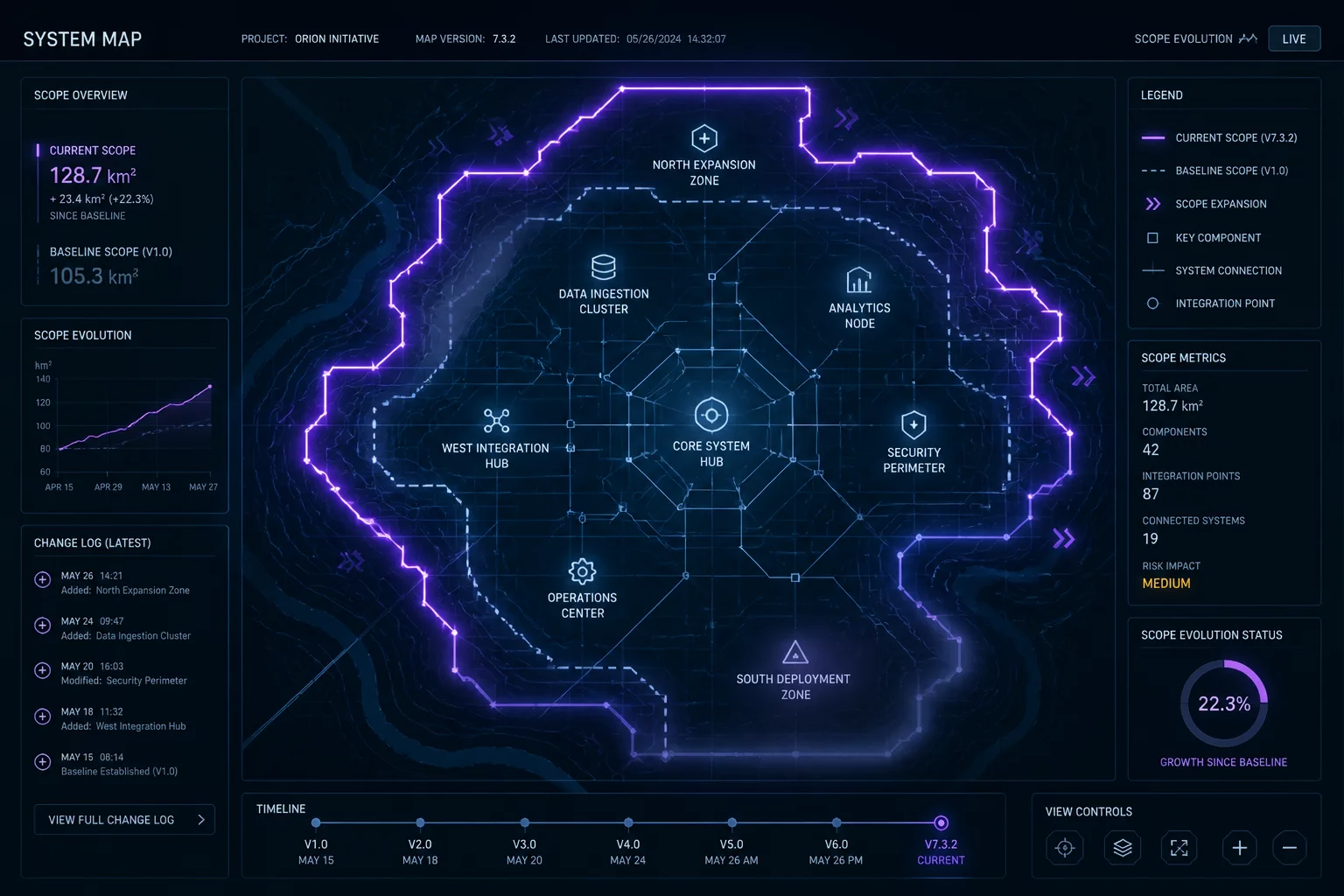
Table of Contents
Navigate through the boundary breakdown sections.
Boundary Drift & Discovery Dynamics
Understanding why system perimeters fluctuate during implementation when assumptions meet real integration constraints.
System boundaries rarely remain stationary once software engineers and product teams begin concrete integration work. Initial architecture blueprints delineate clean service lines and distinct responsibilities, yet unexpected operational realities inevitably push components across demarcations. When edge cases emerge or external supplier capabilities fall short of documentation, teams stretch their service envelopes to keep milestones intact.
This movement produces unmonitored scope expansion and friction between cooperating teams. A service initially tasked with simple notification relaying suddenly absorbs user preference tracking and compliance storage because the upstream platform lacks appropriate endpoints. Unless documented immediately, this relocation leaves downstream dependencies vulnerable to undocumented failure points and overlapping data models.
“A moving boundary indicates either poorly articulated interface constraints or shifting domain responsibilities that must be explicitly renegotiated.”
Root Causes of Interface Migration
Examining structural and operational pressures that cause responsibilities to drift across system lines during delivery.
Boundary dislocation seldom happens intentionally; it occurs through tactical compromises made under delivery deadlines. When an upstream team lacks bandwidth to expose required domain fields, the consuming team writes custom transformation layers and persists cache tables internally, shifting domain ownership without formal review.
Key Drivers of Mid-Project Scope Shift
Three primary pressures repeatedly trigger unexpected perimeter displacement across enterprise software initiatives:
- Implicit Data Ownership — Unassigned schema fields defaulting to whichever team touches the ingestion workflow first.
- Mismatched Release Cadences — High-velocity teams taking over legacy batch processes to unblock downstream user features.
- Vendor Contract Gaps — Third-party service limitations forcing internal microservices to construct proxy reconciliation engines.
Key Facts & Parameters
System topology matrices and interface constraints for reference.
| Dimension / Scope Parameter | Designation / Standard |
|---|---|
| Perimeter Shift Frequency | 42% of cross-team interface changes occur post-architecture signoff |
| Primary Trigger Mechanism | Undocumented schema assumptions and missing upstream endpoints |
| Recommended Re-baseline Cadence | Bi-weekly architectural synchronization sprints |
| Interface Contract Type | Explicit schema validation with automated breaking-change detection |
Stabilization & Governance Framework
Establishing clear protocols to detect, evaluate, and formalize structural perimeter movements.
Preventing chaotic boundary drift requires making perimeter shifts visible rather than forbidding them entirely. When a squad realizes it must absorb functionality beyond its architectural charter, it must log an Architecture Decision Record (ADR) before writing integration logic. This mechanism alerts neighboring teams to downstream data flow adjustments and allows architects to decide whether the boundary shift should become permanent or remain a temporary technical debt bridge.
Maintaining synchronized system diagrams in tools like Draw.io ensures all contributors reference the exact same domain limits. Regularly reconciling visual models against live event brokers, API gateways, and repository ownership configurations ensures operational reality mirrors governance documentation across every release cycle.
Architectural Checkpoints & Mitigation
Actionable practices to keep interface contracts predictable and align engineering boundaries across evolving release goals.
When boundary relocations occur, teams must isolate the newly absorbed functionality with clean internal adapters. This abstraction ensures that if the true owner later implements the missing capability, the consumer can deprecate its internal adapter without rewriting core business logic.
Implementation Checklist
- Audit interface crossing points weekly to catch undocumented data transformations before deployment.
- Formalize any boundary movement using an Architecture Decision Record with explicit ownership signoffs.
- Isolate temporary cross-boundary logic behind internal anti-corruption layers for safe future extraction.
Fieldbook Dispatch
Subscribe to System Boundary Analysis Memos
Receive regular architectural pattern updates, scope checklists, and engineering case studies directly in your inbox.
Knowledge Base Archive
Related Boundary Studies


SH
Domain Specialist
Sarah Harris
Senior Enterprise Architect and domain boundaries consultant specializing in software topology, cross-team interfaces, and evolutionary systems design.