
Architecture & Integration
An External Service Is Not an Internal Component
Treating a third-party vendor API or external SaaS as an internal component hides latency, blast radius, failure modes, and governance boundaries.
Author: Robert Taylor
•
Published: 2026-09-25
•
Reading Time: 7 min read

Table of Contents
Navigate through the boundary breakdown sections.
The False Equivalence Fallacy
Why software diagrams that draw external vendors in the same visual tier as internal databases mislead engineering teams.
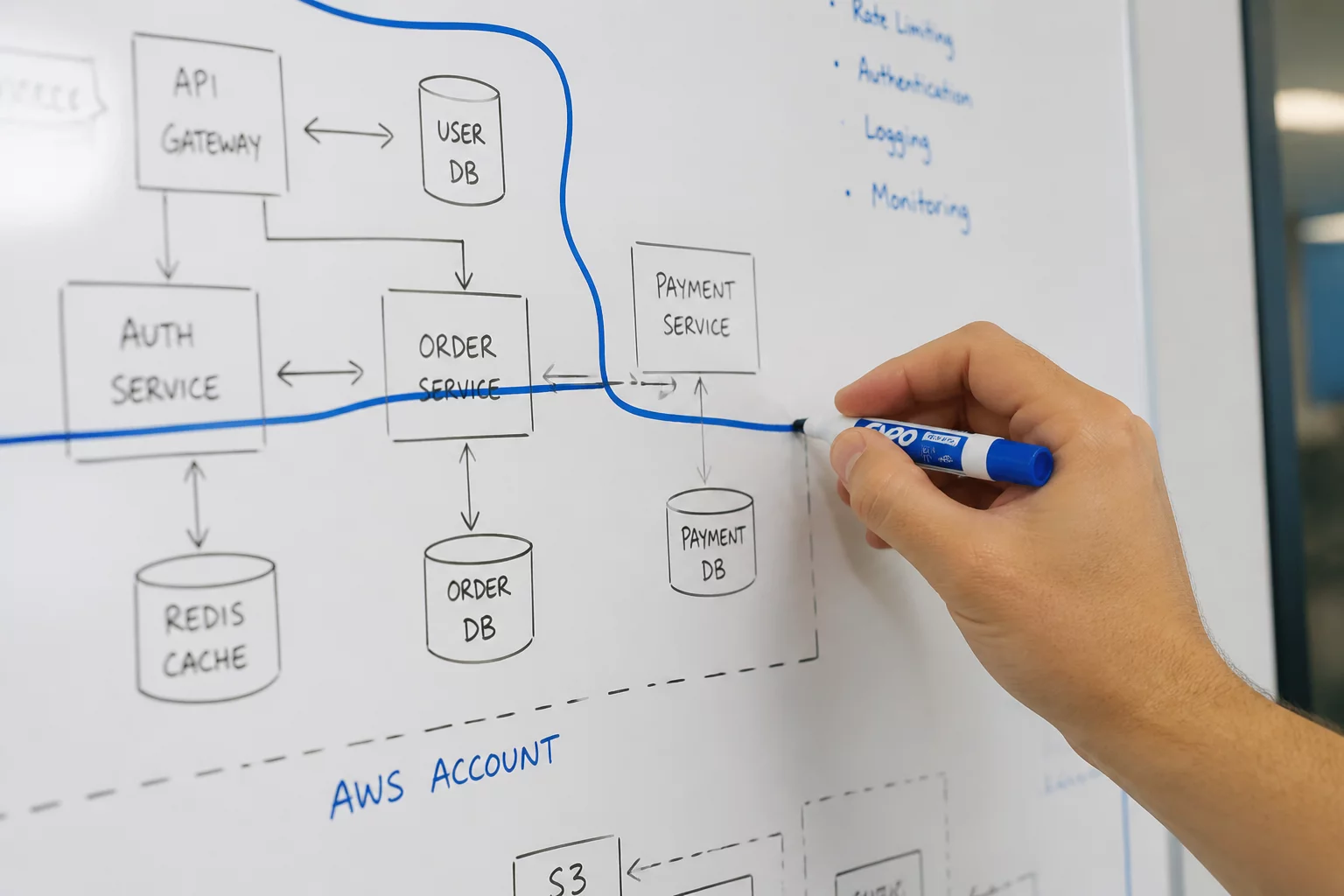
When software engineers draft architectural diagrams, external APIs often appear as simple rectangular boxes neatly aligned alongside internal microservices or database clusters. This visual shorthand creates a dangerous illusion of symmetric reliability, uniform latency, and identical governance. An internal component operates under direct engineering control: your team owns its source code, controls deployment cadences, instruments shared telemetry, and adjusts thread pooling or horizontal scaling on demand.
An external service operates in a fundamentally different trust and control domain. It presents unpredictable network jitter, black-box outages, opaque rate limits, breaking schema migrations, and unilateral SLA deprecations. Representing both elements with the same visual weight obscures operational boundaries and leads engineering teams to neglect essential defensive integration patterns such as circuit breakers, fallback caches, and asynchronous dead-letter queues.
An external dependency is an unpredictable partner behind a network wire, never an obedient internal module.
Failure Divergence & Blast Radius
Exploring how operational characteristics diverge rapidly when crossing trust perimeters.
Internal components fail predictably along known infrastructure bounds. Memory leaks trigger container restarts, database pool starvation throws localized connection exceptions, and compute instances scale out under queue backpressure. When an external payment gateway, identity provider, or logistics platform degrades, its failure manifests outside your telemetry visibility, often hanging socket connections indefinitely rather than returning clean HTTP 500 errors.
Essential Boundary Failure Vectors
When architectural models fail to distinguish between internal components and external third parties, systems routinely suffer from cascading resource exhaustion caused by unbuffered synchronous calls.
- Latency creep that ties up web server worker threads while waiting for unthrottled third-party HTTP responses.
- Contract erosion where vendor payload structure changes propagate unchecked throughout internal domain models.
- False SLA assumptions where a 99.99% internal uptime goal is undermined by a 99.5% single-threaded vendor dependency.
Key Facts & Parameters
System topology matrices and interface constraints for reference.
| Dimension / Scope Parameter | Designation / Standard |
|---|---|
| Governance & Control Domain | Third-party legal entity; outside internal change management & deployment cycles. |
| Telemetry & Observability | Black-box boundary; metrics limited to ingress/egress client probes and edge status. |
| Transport & Network Protocol | Public internet / mTLS edge proxy with variable latency and transient packet loss. |
| Resilience Architecture | Mandatory Anti-Corruption Layer (ACL), Circuit Breakers, and Fallback State. |
The Anti-Corruption & Isolation Pattern
Isolating external schemas and protocols behind explicit architectural shock absorbers.
Domain-Driven Design emphasizes the Anti-Corruption Layer (ACL) as a vital translation membrane between divergent domain models. An internal subsystem should never consume raw vendor DTOs or proprietary response payloads directly within core domain logic. Wrapping the third-party client inside an adapter translates vendor-specific vocabularies into clean, internally governed ubiquitous language.
Beyond data transformation, the ACL provides a strict operational boundary. It encapsulates bulkhead thread pools, exponential backoff retries, idempotent transaction keys, and fallback responses. If the external provider experiences extended downtime or raises billing tiers, swapping the integration requires modifying solely the adapter layer rather than refactoring dozens of core business services.
Pragmatic System Takeaways
Concrete steps for refactoring system diagrams and integration topology.
Effective architecture documentation explicitly demarks trust perimeters using visual boundaries, distinct styling, and explicit network crossing arrows. Every integration point crossing the perimeter must define concrete fallback behavior.
Implementation Checklist
- Audit all architectural diagrams to place external vendors outside the primary system boundary box with dedicated edge gateway nodes.
- Enforce Anti-Corruption Layers and contract adapters to prevent vendor data schemas from leaking into domain entities.
- Configure explicit circuit breakers, aggressive read timeouts (sub-500ms where feasible), and graceful fallback caches for every third-party HTTP invocation.
Fieldbook Dispatch
Subscribe to System Boundary Analysis Memos
Receive regular architectural pattern updates, scope checklists, and engineering case studies directly in your inbox.
Knowledge Base Archive
Related Boundary Studies


RT
Domain Specialist
Robert Taylor
Senior Principal Solutions Architect specializing in distributed systems resilience, bounded contexts, and high-availability integration design across enterprise architectures.