

Architecture Memo
The System Boundary Was Drawn Around the Wrong Things
When engineering diagrams delineate technical components instead of transactional life cycles, ownership collapses and friction spreads across deploy cycles.
Author: James Wilson
•
Published: October 1, 2026
•
Reading Time: 6 min read
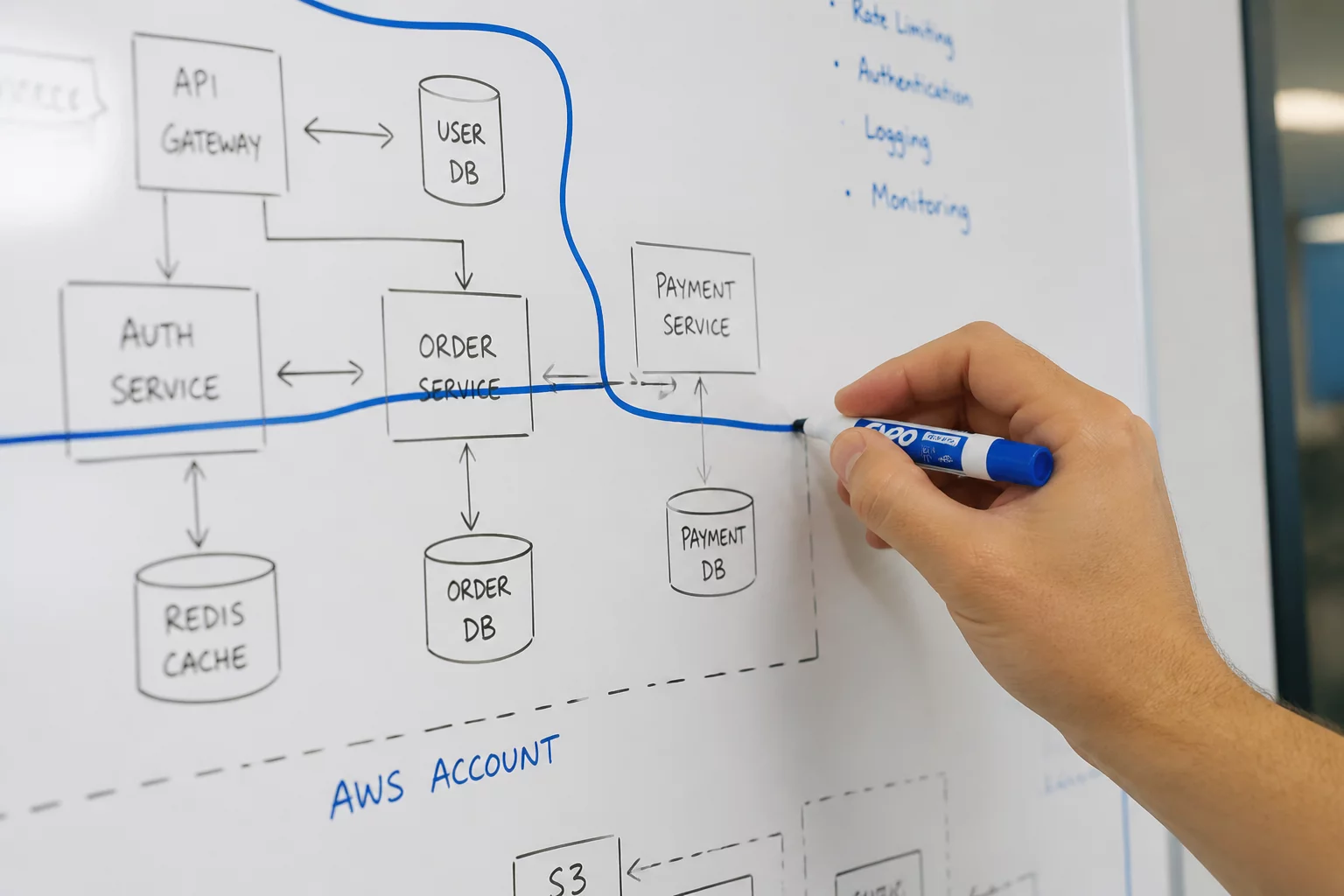
Table of Contents
Navigate through the boundary breakdown sections.
Diagnostic: The Symptom of Broken Enclosures
A misplaced boundary creates silent coupling and cross-team dependencies before anyone pushes code to production.
Architectural diagrams often group software artifacts by superficial technical categories rather than independent lifecycle boundaries. When engineers place a shared cache, background workers, and core storage within a single monolithic perimeter, they unintentionally bundle distinct failure domains together.
The friction surfaces during routine deployments. One squad modifies a database schema expecting isolated scope, only to trigger cascading outages in adjacent subsystems that had no formal contractual obligations.
A system boundary is an ownership contract, not a visual container for nearby servers.
Root Cause Analysis: Functional vs Organizational Lines
Why engineering teams repeatedly draw borders around the wrong entities.
Most system boundaries are drawn according to software topology rather than behavioral autonomy. Infrastructure diagrams show networking subnets, but fail to delineate where transactional authority actually transfers between independent business capabilities.
Three Critical Anti-Patterns in Boundary Construction
When evaluating architectural friction points, three distinct design errors frequently appear in legacy documentation:
- Encapsulating shared state inside client components rather than dedicated authority boundaries.
- Treating external third-party webhooks as internal synchronously controlled actors.
- Drawing perimeters around team structures rather than business bounded contexts.
Key Facts & Parameters
System topology matrices and interface constraints for reference.
| Dimension / Scope Parameter | Designation / Standard |
|---|---|
| Primary Failure Mode | Cascading schema drift across untracked boundaries |
| Isolation Metric | Deploy-time decoupling ratio (< 15% cross-service changes) |
| Contract Enforcement | Strict API schema versioning at domain entry points |
| Standard Reference | Domain-Driven Design (DDD) Bounded Context Specification |
Boundary Mapping Framework & Rules
Establishing immutable principles for drawing resilient system perimeters.
Every valid boundary must satisfy two core requirements: autonomous lifecycle execution and explicit interface contracts. If a service cannot deploy independently or change its data representation without synchronizing release calendars with three other teams, the boundary line is positioned incorrectly.
Redrawing the line requires isolating state ownership. External systems, shared background jobs, and partner interfaces must sit outside the primary domain boundary, communicating exclusively across well-defined gateway adapters.
Operational Takeaways & Resolution Steps
Practical adjustments to reconstruct system diagrams and decouple production services.
Correcting an erroneous boundary does not require an immediate code rewrite; it begins by documenting true dependency vectors on architectural blueprints.
Implementation Checklist
- Audit all shared databases and classify authoritative ownership per entity.
- Redraw system diagrams to place external services and async workers outside domain cores.
- Introduce semantic versioning on boundary crossing payloads to prevent silent breakage.
Fieldbook Dispatch
Subscribe to System Boundary Analysis Memos
Receive regular architectural pattern updates, scope checklists, and engineering case studies directly in your inbox.
Knowledge Base Archive
Related Boundary Studies

JW
Domain Specialist
James Wilson
James Wilson is a Principal Systems Architect specializing in domain boundaries, microservices segregation, and resilient distributed patterns across enterprise software environments.