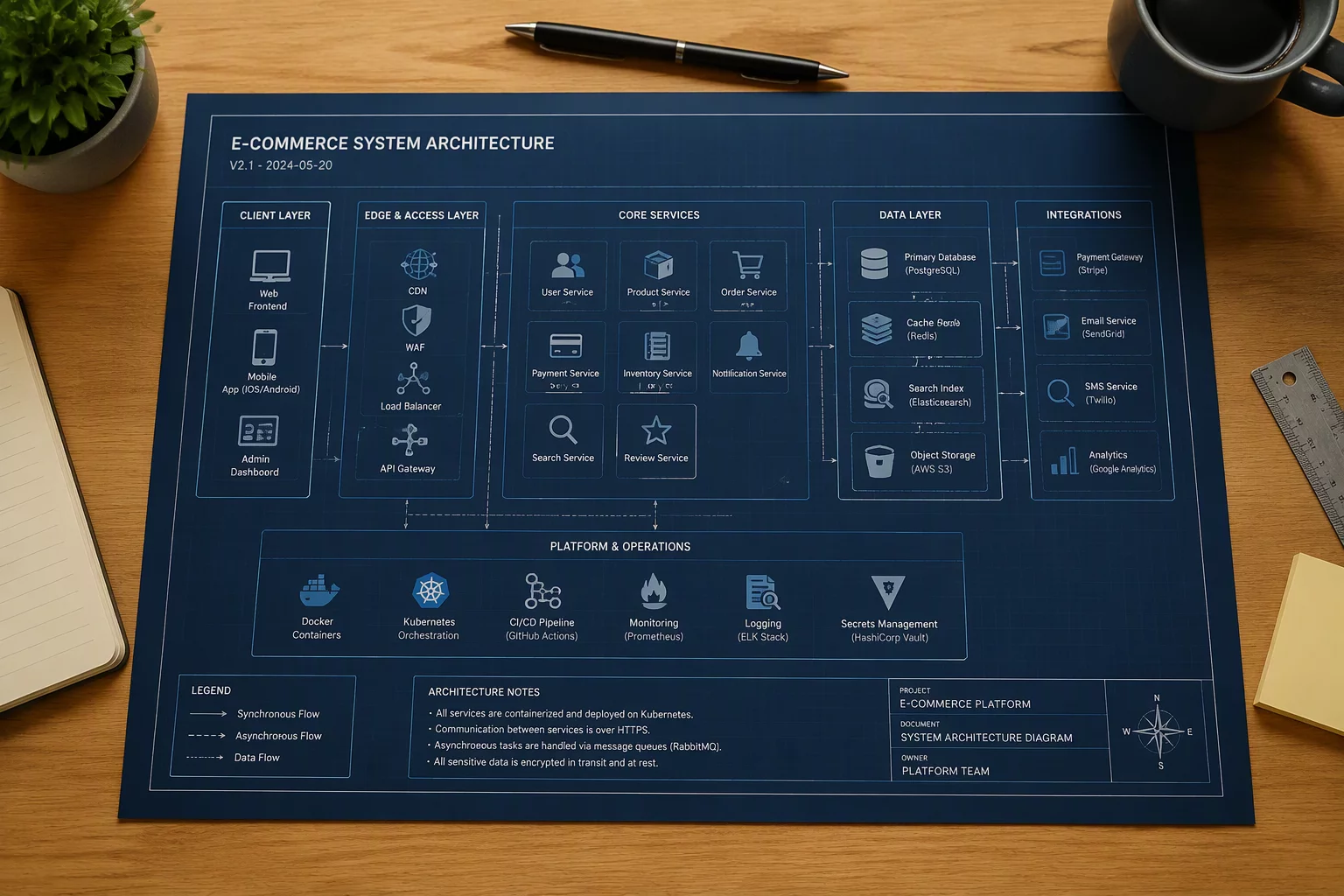
E-commerce System Boundary Reorganization
A deep dive into reorganizing the boundaries of a complex e-commerce system to clarify team ownership and isolate critical business workflows.
Make It Clear What Belongs to the System, What Sits Outside It, and What Crosses Between. Explore practical boundary maps for responsibilities, external dependencies, information exchanges, and project scope.
Arthur Vance
Principal Systems Architect
Throughout two decades of structuring distributed systems, I observed one invariant reality: initiatives rarely stumble because of raw code deficiencies or inadequate hardware. They disintegrate when teams fail to delineate where one responsibility boundary ends and another begins.
When domain ownership remains ambiguous, shared data models inevitably evolve into unmanageable contention points, external dependencies masquerade as internal subroutines, and architectural debt compounds in silence. BoundaryFrame Fieldbook was created to provide practitioners with rigorous, battle-tested methods for mapping interfaces, ownership boundaries, and operational scopes with absolute clarity.

Arthur Vance
Founder & Author
A rigorous framework for isolating technical complexity, clarifying domain ownership, and eliminating cross-team friction across software systems.
Defines precise technical scopes, logical component encapsulation, and distinct execution environments to isolate computational duties.
Aligns engineering ownership zones with Conway's Law, establishing unambiguous operational custodianship for every service.
Explicitly demarcates deliverable limits, baseline scope definitions, and out-of-scope functional requirements on blueprints.
Identifies third-party APIs, vendor contracts, latency assumptions, and SLA risk surfaces outside the core platform.
Structures formal payload validation, translation layers, anti-corruption patterns, and serialization protocols at crossing points.
Regulates shared databases, common pipelines, and multi-tenant assets to prevent tangled couplings and migration deadlock.
Analyzes common degradation patterns, leaky domain abstractions, and cascading outages caused by unmanaged coupling.
Synthesizes all layers into complete, holistically documented enterprise architecture diagrams ready for organizational execution.
A comprehensive analysis of false coupling, blurred system perimeters, and the critical separation between vendor-managed components and core application boundaries.
During rapid feature delivery, the product team embedded a third-party managed billing service directly into internal domain data flows. Because the vendor provided an SDK with local synchronous classes, engineering treated it as an internal library rather than an autonomous external service governed by latency, uptime contracts, and network isolation.
Components and data structures strictly controlled, versioned, and guaranteed by internal service teams:
Autonomous external services running under third-party uptime SLAs, schema cycles, and security limits:
Points where communication transitions between trusted local state and unpredictable external networks:
Incoming signature verification, idempotent deduplication table matching, and immediate dispatch to internal worker queues.
Circuit-breaker protected HTTP queries with strict 450ms timeouts and graceful degradation fallbacks to cached entitlements.
Every team must resolve these operational boundaries prior to production signoff:
A step-by-step engineering pathway designed to identify architectural friction, isolate bounded contexts, and establish clean team contracts.
We examine existing data flows, shared storage dependencies, and implicit project handoffs to pinpoint where responsibility is currently ambiguous.
Domain perimeters are clarified by defining which team holds source-of-truth authority, eliminating conflicting writes and overlapping operational roles.
Precise boundary crossing contracts are formulated, detailing payload validation, idempotency guards, and event publishing protocols.
Structured architectural guardrails and living documentation are embedded into team workflows to keep boundaries stable as systems scale.
Independent analyses and publications on our domain boundary heuristics, responsibility structures, and architecture frameworks.
“BoundaryFrame establishes the missing analytical standard for establishing explicit service perimeters across distributed platforms.”
“An indispensable field guide for system designers striving to untangle shared databases and fragmented engineering scopes.”
“Replaces ambiguous system diagrams with structured boundary blueprints that eliminate cross-team responsibility deadlocks.”
“Concrete patterns that show engineering leaders exactly where system ownership changes hands and what crosses every perimeter.”
Systematic frameworks and proven methodologies for defining resilient software boundaries and team ownership.
A deep dive into reorganizing the boundaries of a complex e-commerce system to clarify team ownership and isolate critical business workflows.
Diagnostic indicators that reveal mismatched responsibility domains and practical techniques to redraw boundaries around core business invariants.
Comprehensive course covering fundamental architectural framing, contextual mapping, and team interface contracts for complex engineering setups.
Resolve these accountability boundaries before any integration reaches production.
Submit your contact information to connect with a senior systems analyst. We evaluate organizational boundaries, domain ownership, and cross-boundary dependencies.
Next steps: Following submission, an architect conducts a preliminary review of your system specifications and contacts you within 1 business day with structured boundary recommendations.