

Deconstructing System Perimeters with draw.io Containers
Clear visual boundaries prevent cross-team ambiguities, eliminate hidden external coupling, and clarify interface contracts across enterprise software topologies.
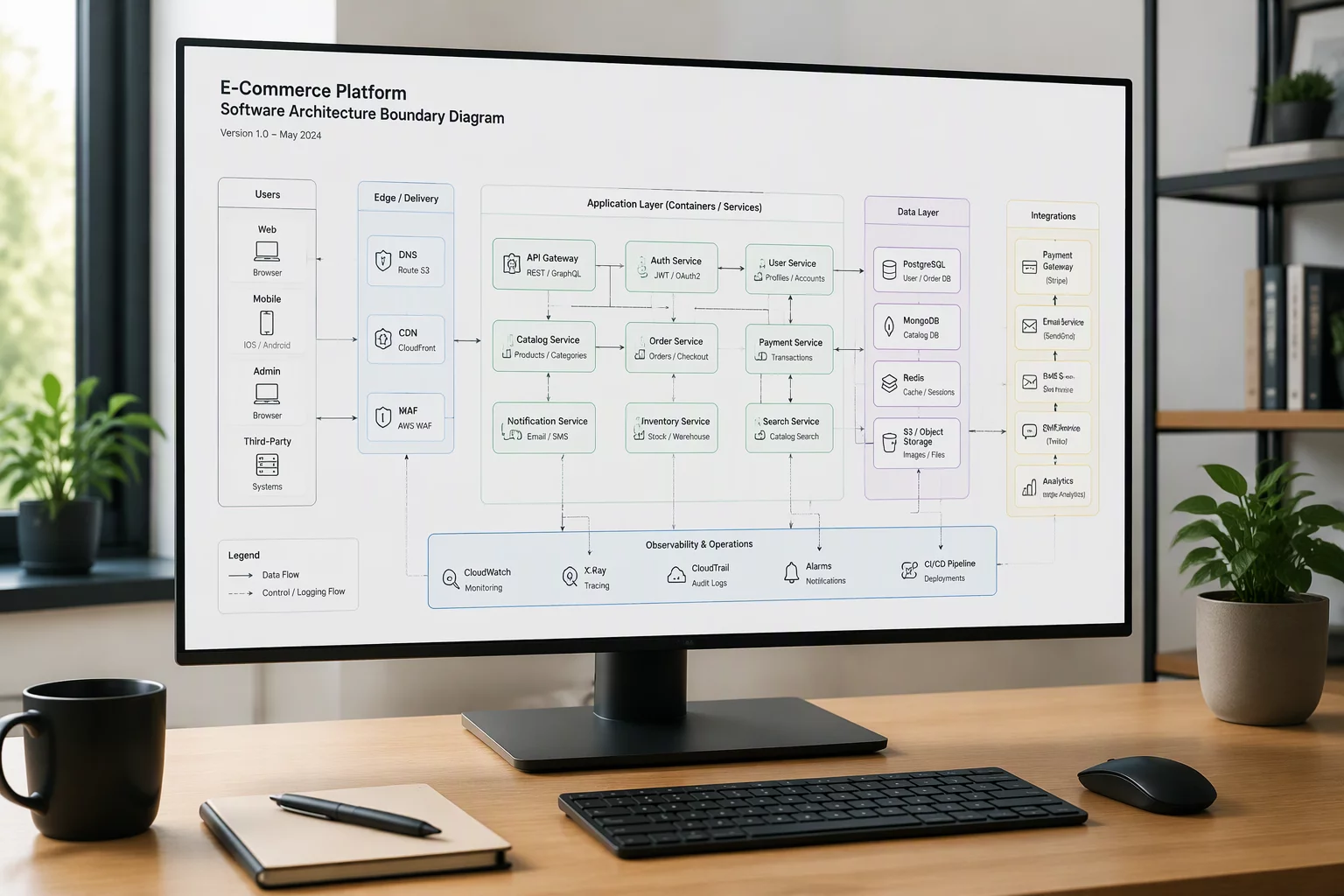
Layered Boundary Model for Microservices and Third-Party Gateways
Using nested swimlanes, explicit bounding containers, and color-coded connector conduits to represent synchronous API calls versus asynchronous event streams crossing isolation perimeters.
Internal Component Isolation
Grouping bounded context services into dedicated draw.io container shapes to enforce clear encapsulation and prevent unintended coupling between modules.
External Dependency Demarcation
Styling SaaS providers, legacy databases, and partner APIs with dashed perimeter strokes and explicit ingress/egress validation badges.
Responsibility Zone Overlay
Assigning engineering squad ownership tags directly to visual containers to ensure on-call duty, SLA accountability, and deploy permissions match diagram topologies.
Container & Group Hierarchy
Structure nested containers with locked layer dimensions to ensure internal nodes remain bounded during refactoring cycles.
Connector Metadata & Keys
Label boundary crossings with payload formats (JSON, gRPC, Avro), protocol types, and authentication requirements.
Multi-Layer Scope Views
Toggle visibility layers for infrastructure boundaries, data residency compliance perimeters, and business capability clusters.
Core Principles for Maintaining Long-Term Diagram Accuracy
Applying robust documentation habits in draw.io guarantees architecture models evolve in lockstep with codebase reality.
Contract First Connectors
Every arrow traversing a boundary must reference an explicit API schema or contract repository URL in its shape data.
Immutable Boundary Styles
Use pre-configured XML style templates for solid system boundaries, dashed third-party perimeters, and dotted team clusters.
Version-Controlled Diagrams
Store diagram files as raw XML or embedded SVG files alongside code in Git repositories to enforce code-review checkpoints.
Trust Boundary Tagging
Highlight zero-trust segmentation zones and credential inspection points explicitly to assist security and compliance audits.
Blast Radius Indication
Identify cascading failure risks by labeling fallback circuits, rate limiters, and bulkhead patterns across service borders.
Team Ownership Metadata
Embed Slack channel handles and service catalog IDs directly inside shape tooltips to speed up cross-team incident resolution.
Extend Your Boundary Mapping Toolkit Across Teams
Discover additional implementation blueprints, architectural patterns, and hands-on guidance to align software domain boundaries with organizational workflows.