
Knowledge Base Memo
Inside the Project but Outside the Team
Untangling organizational dependencies, shared platform components, and cross-functional deliverables that sit inside project scope but outside team authority.
Author: Linda Martinez
•
Published: September 28, 2026
•
Reading Time: 6 min read

Table of Contents
Navigate through the boundary breakdown sections.
The Anatomy of the In-Scope / Out-of-Team Paradox
Why technical architectures suffer when project deliverable scope diverges from team governance limits.
In complex enterprise architectures, critical dependencies frequently emerge that belong strictly to the project roadmap yet fall outside the immediate engineering team's control. Teams discover early during execution that while a service, data store, or security proxy is essential for the system release, another department or shared services pod retains exclusive commit rights.
This organizational boundary mismatch creates an illusion of autonomy. Developers assume end-to-end delivery accountability while lacking the administrative privileges to alter data schemas, configure rate limits, or provision cloud ingress resources.
Project boundaries define what must succeed; team boundaries define what you can actually change without external negotiation.
Mapping Boundary Disconnects in Practice
Systematic symptoms indicating that an architectural element is within project scope but outside team ownership.
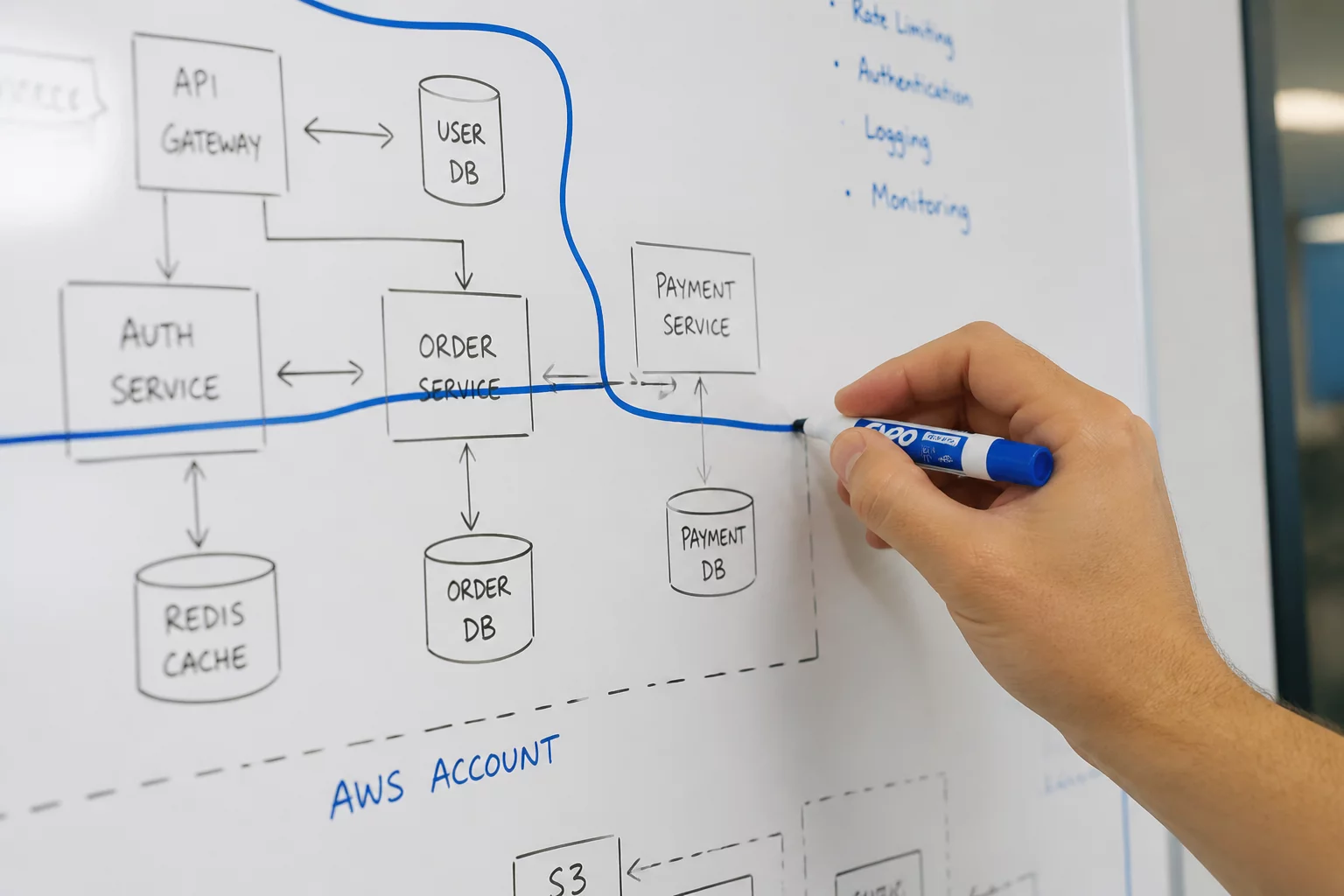
When analyzing system boundaries, architects often draw a single enclosing container around every component involved in a business workflow. This monolithic scoping obscures critical organizational friction points where delivery momentum halts due to lack of direct commit access.
Key Warning Signals in Topology Diagrams
System diagrams that overlook team boundaries introduce hidden operational bottlenecks. Recognize these typical indicators during architectural reviews:
- Cross-boundary synchronous RPC calls requiring third-party schedule coordination for backward-incompatible releases.
- Shared database tables accessed across departmental perimeters without schema ownership contracts.
- Deployment pipelines dependent on external manual sign-offs or central platform team ticket queues.
Key Facts & Parameters
System topology matrices and interface constraints for reference.
| Dimension / Scope Parameter | Designation / Standard |
|---|---|
| Scope Classification | In-Project / External Pod Dependency |
| Contract Protocol | Versioned OpenAPI Specification + Schema Registry |
| Boundary Governance | Consumer-Driven Contract (CDC) Testing Suite |
| Escalation SLA Threshold | 4 Hours for Blocking Schema Divergence |
Contract-First Decoupling Patterns
Engineering strategies to insulate internal velocity from external team constraints.
Mitigate cross-team friction by establishing rigorous interface contracts before implementing core business logic. Build anti-corruption layers and consumer-driven contract tests to detect drift in shared infrastructure early. This isolates your internal sprint cycles from external sprint cadences.
Maintain explicit boundary mock servers for local development and CI execution. By simulating external components against agreed API schemas, engineering pods avoid idle cycles while awaiting upstream team deliverables or infrastructure configurations.
Practical Implementation Checklist
Concrete steps to align team accountability with overall project boundaries.
Resolving boundary ambiguity requires structural discipline across technical diagrams and delivery workflows. Ensure every box on your architecture diagrams clearly reflects both operational domain and organizational ownership.
Implementation Checklist
- Annotate every diagram node with the responsible team alias and commit repository URL.
- Implement mock interfaces and fallback degradation paths for all external in-scope services.
- Document explicit Service Level Objectives (SLOs) and escalation paths in project architecture decision records (ADRs).
Fieldbook Dispatch
Subscribe to System Boundary Analysis Memos
Receive regular architectural pattern updates, scope checklists, and engineering case studies directly in your inbox.
Knowledge Base Archive
Related Boundary Studies


LM
Domain Specialist
Linda Martinez
Principal Systems Architect and boundaries researcher specializing in cross-functional software topologies, Conway's law adaptations, and enterprise interface governance.